(Sparse) Koopman regularization enables PINNs to generalize beyond training domains.
Center for AI Research PH
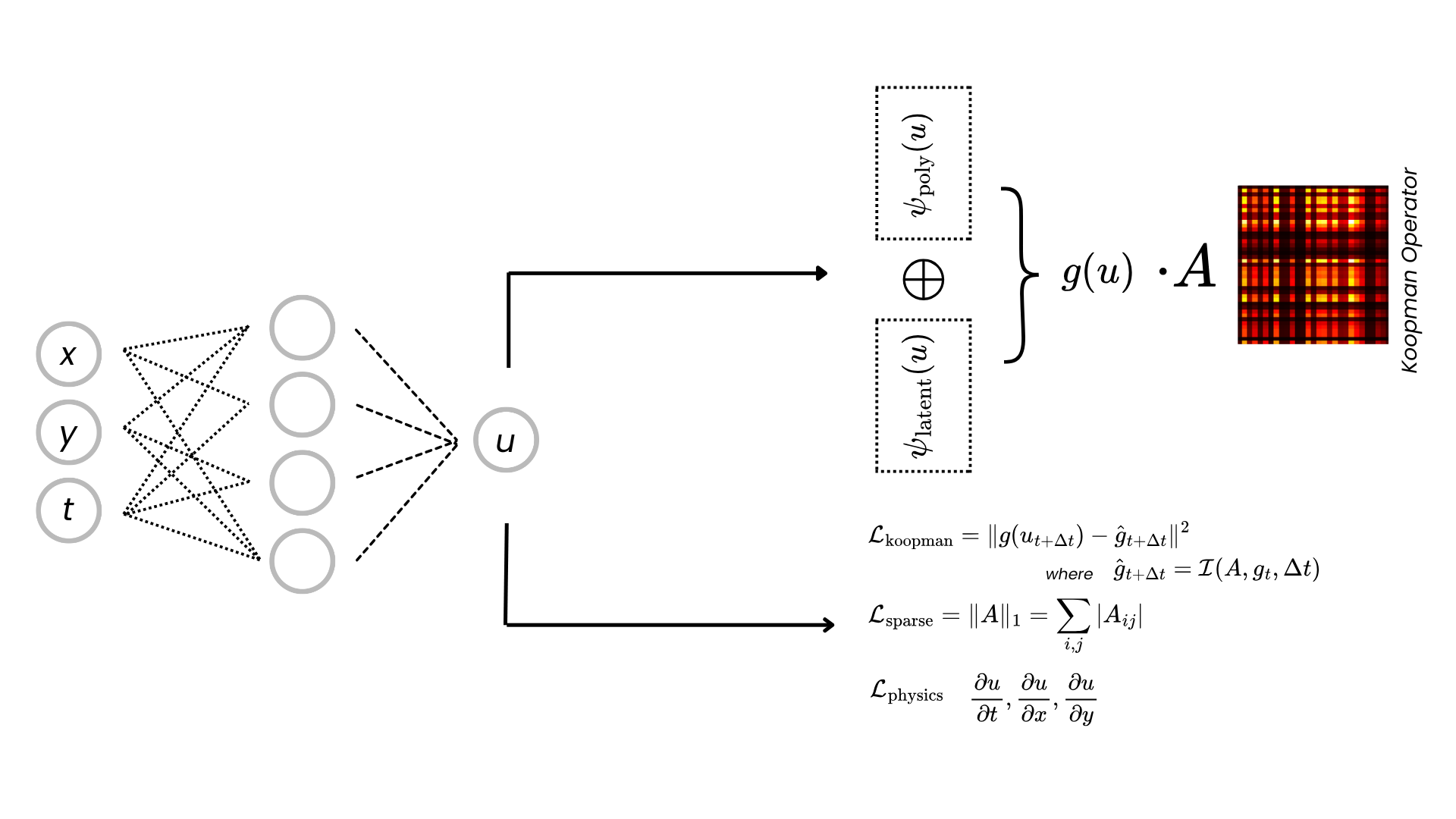
Figure 1. A standard PINN encoder maps coordinates (x, y, t) to the solution field u. A dual observable embedding — an explicit polynomial library ψpoly plus a learned latent map ψlatent — lifts u into a space where a continuous-time Koopman operator enforces linear dynamics dz/dt = Az. An L1 penalty on A drives it toward a sparse, interpretable generator (heatmap, right).
Physics-Informed Neural Networks (PINNs) solve differential equations mesh-free by embedding physical constraints into training, but they tend to overfit the training domain and generalize poorly when extrapolating beyond it. SPIKE (Sparse Physics-Informed Koopman-Enhanced) regularizes PINNs with continuous-time Koopman operators to learn parsimonious dynamics. By enforcing linear dynamics dz/dt = Az in a learned observable space, both PIKE (without explicit sparsity) and SPIKE (with L1 regularization on A) learn sparse generator matrices, embodying the parsimony principle that complex dynamics admit low-dimensional structure. Across parabolic, hyperbolic, dispersive, and stiff PDEs, including fluid dynamics (Navier–Stokes) and chaotic ODEs (Lorenz), SPIKE delivers consistent gains in temporal extrapolation, spatial generalization, and long-term prediction accuracy. The continuous-time formulation with matrix-exponential integration provides unconditional stability for stiff systems.
Rather than bolting physics onto a Koopman autoencoder, SPIKE keeps the PINN as the base model and adds Koopman structure as an auxiliary regularizer that promotes sparse, interpretable dynamics.
L1 regularization on A reduces non-zero entries by up to 5.7×, capturing complex PDE dynamics with sparse generator matrices — and even fixing unstable spectra (reaction-diffusion).
An explicit polynomial library (capturing terms like u−u³) combines with a learned latent map that correlates with hidden structure — up to 0.99 with uxx.
Learning dz/dt = Az directly avoids the diagonal-dominance trap of discrete-time Koopman (K → I as Δt → 0). Matrix-exponential integration gives unconditional stability.
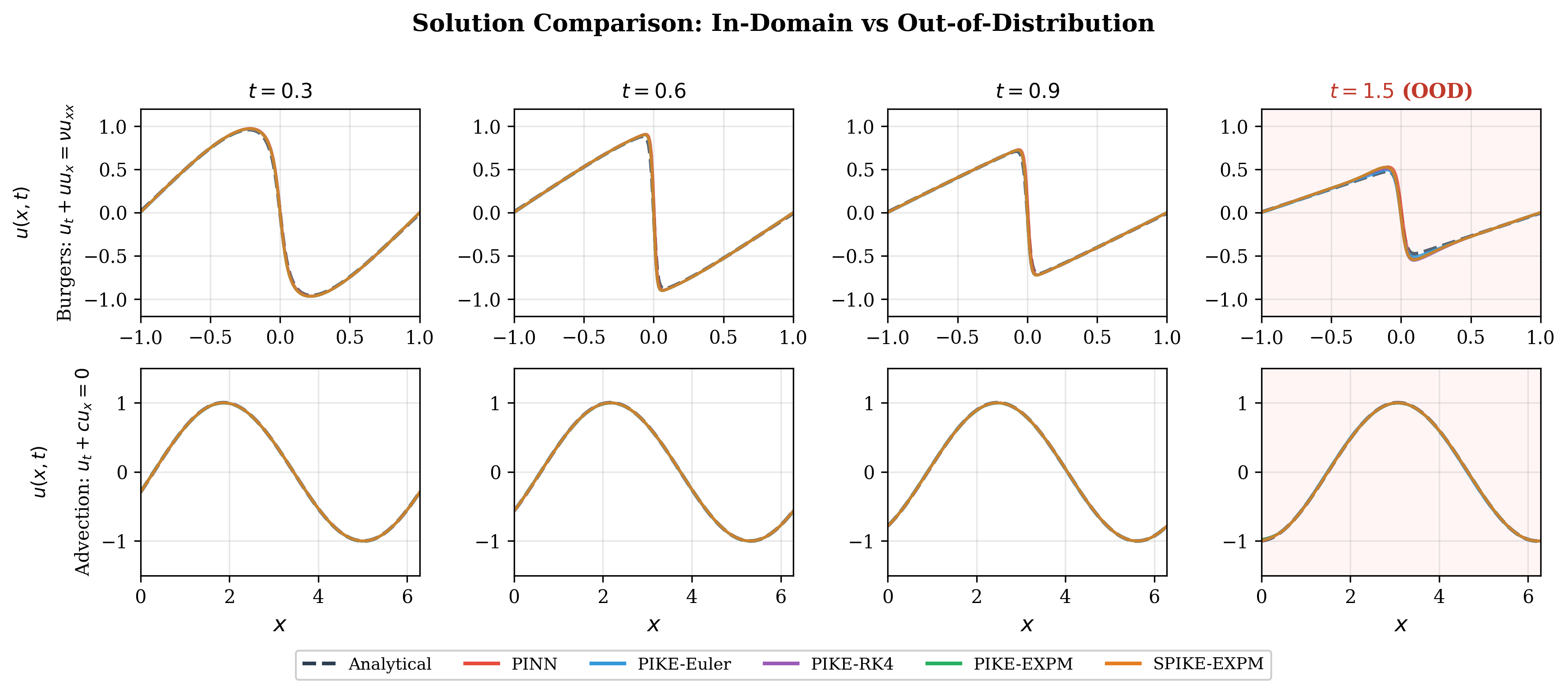
Solutions stay accurate not only in-domain but when extrapolating in time. The shaded panels (red) sit outside the training window t∈[0,1].
Figure 2. In-domain vs. out-of-distribution solutions. Burgers (top) and advection (bottom) at increasing times. Every method matches the analytical solution in-domain; the regularized variants continue to track it at t=1.5, beyond the training window.
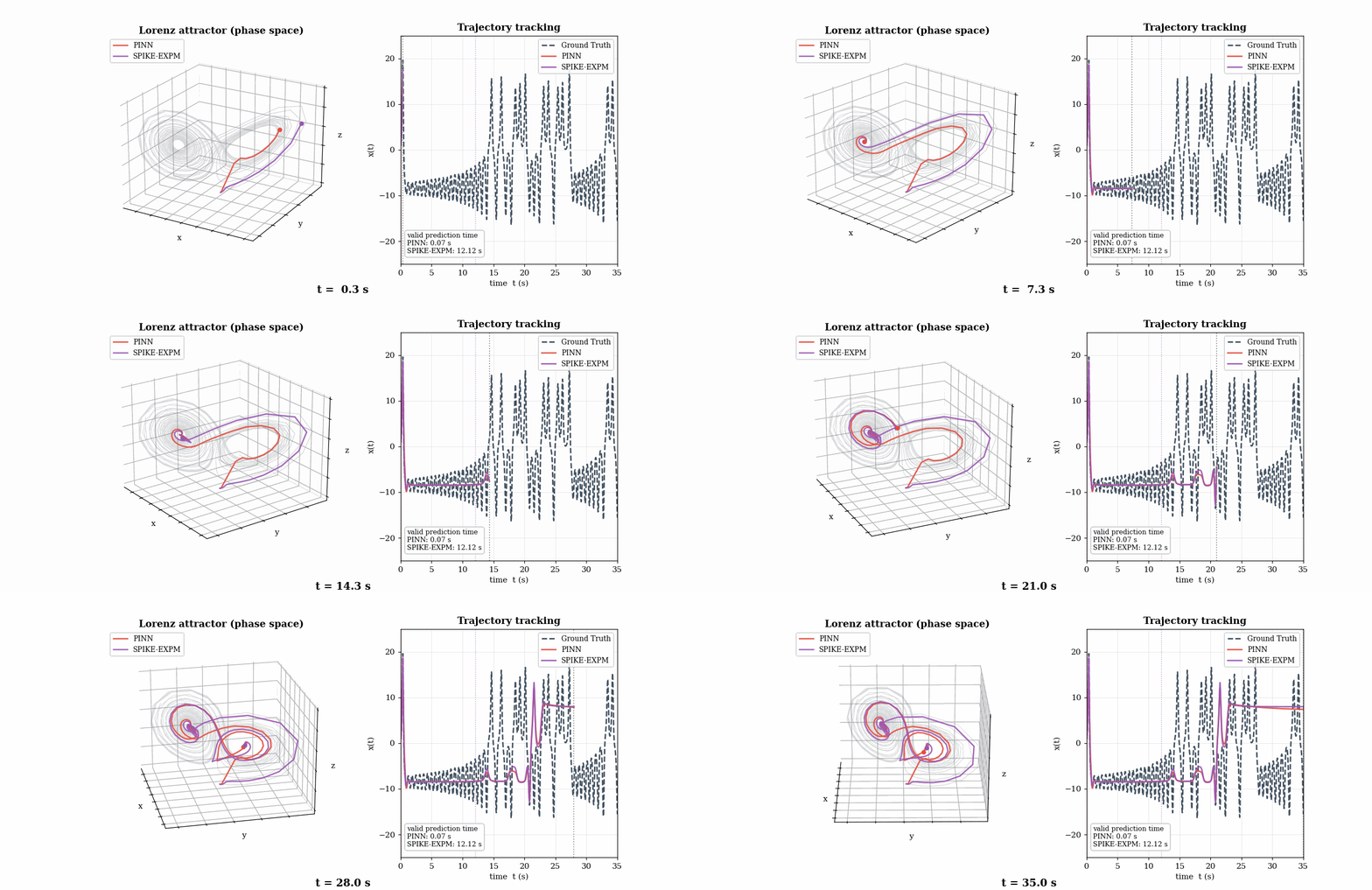
Lorenz attractor. The continuous-time Koopman variant (SPIKE-EXPM) stays within the error threshold for 12.1 s versus 0.07 s for the baseline PINN — an order-of-magnitude longer horizon on a chaotic system.
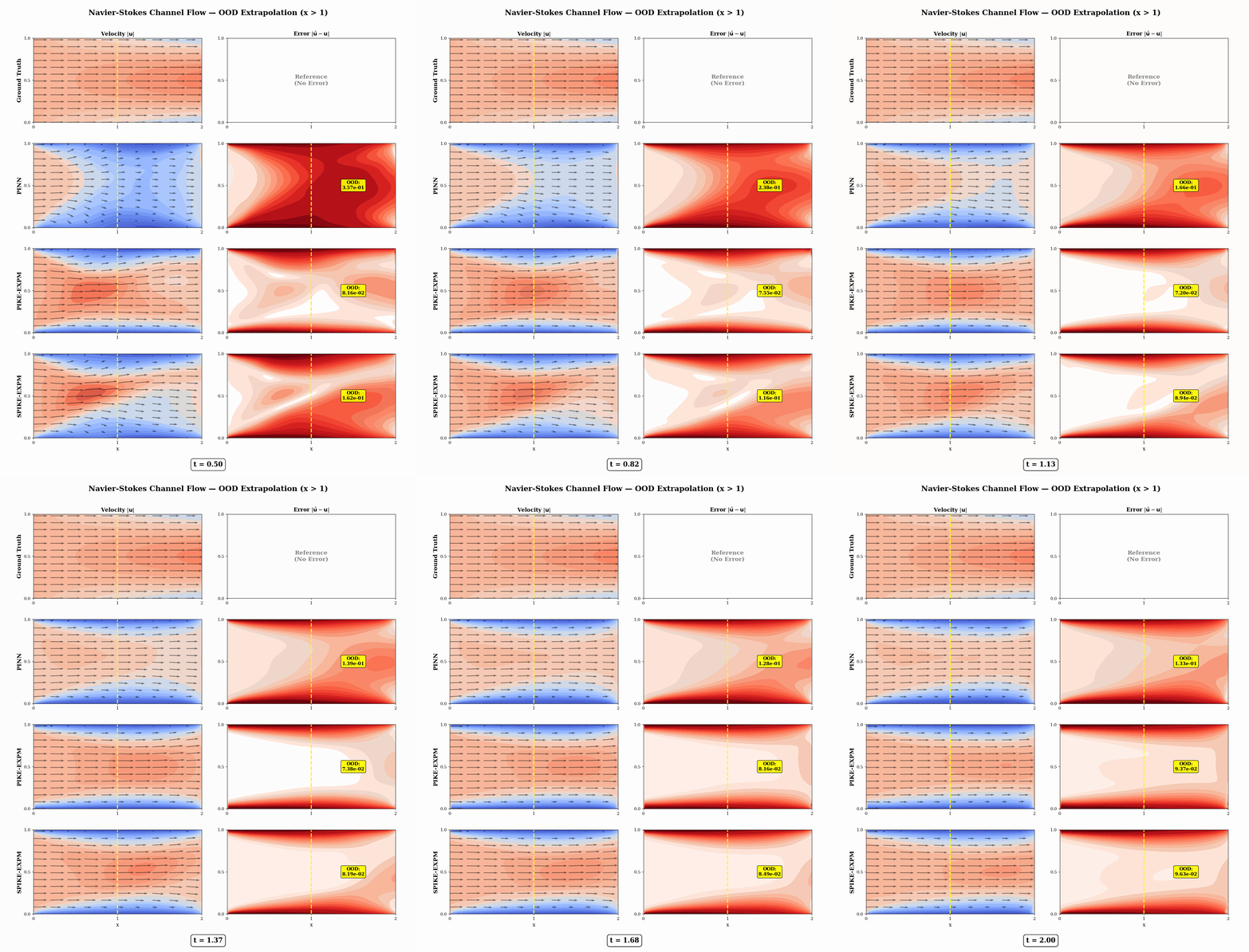
Navier–Stokes channel flow. Predicting downstream (x∈[1,2]) of the training region, PIKE-EXPM reaches 7.1×10⁻² MSE vs. the PINN's 3.9×10⁻¹ — a 5.5× reduction.
Physics-residual MSE (lower is better) across systems and generalization regimes, plus Koopman diagnostics. Best per row in blue. Full results for all systems are in the repository.
Summary of Key Improvements over the PINN Baseline (grouped by metric type)
| System | Metric | Improvement | Best Method |
|---|---|---|---|
| In-Domain MSE | |||
| 2D Wave | in-domain | 8×10⁷× | PIKE-Euler |
| Cahn-Hilliard | in-domain | 106× | PIKE-Euler |
| OOD-Space MSE (extrapolation beyond training domain) | |||
| 2D Burgers† | xy ∈ [1,2] | 38× | PIKE-Euler |
| Advection† | x ∈ [3,5] | 29× | SPIKE-EXPM |
| Allen-Cahn† | x ∈ [3,5] | 7.5× | PIKE-Euler |
| Navier-Stokes | xy ∈ [1,2] | 32× | PIKE-Euler |
| Kuramoto-Sivashinsky | x ∈ [3,5] | 2.1× | SPIKE-EXPM |
| OOD-Time MSE | |||
| Schrodinger | t ∈ [3,5] | 24× | SPIKE-EXPM |
| KdV | t ∈ [3,5] | 6.3× | PIKE-EXPM |
| Burgers | t ∈ [3,5] | 2.4× | PIKE-Euler |
| Kuramoto-Sivashinsky | t ∈ [3,5] | 2.8× | PIKE-RK4 |
| Chaotic Systems (Valid Prediction Time) | |||
| Lorenz | valid time | 184× | PIKE-Euler |
†Bounded-domain problems where spatial extrapolation demonstrates model capability rather than physical prediction. Improvement = PINN MSE / best-method MSE (higher is better).
1D PDEs — In-Domain Physics Residual MSE (x, t ∈ [0,1])
| PDE | PINN | PIKE-Euler | PIKE-RK4 | PIKE-EXPM | SPIKE-EXPM |
|---|---|---|---|---|---|
| heat | 1.01e-5 | 6.95e-6 | 1.20e-5 | 6.02e-6 | 8.67e-6 |
| advection | 5.04e-7 | 8.89e-5 | 4.45e-7 | 4.88e-7 | 3.90e-7 |
| burgers | 9.68e-5 | 4.63e-5 | 3.44e-5 | 3.23e-5 | 3.23e-5 |
| allen-cahn | 1.19e-5 | 1.56e-5 | 1.44e-5 | 2.34e-5 | 7.08e-5 |
| kdv | 5.23e-2 | 4.75e-2 | 5.24e-2 | 5.06e-2 | 5.14e-2 |
| reaction-diffusion | 5.02e-5 | 2.67e-4 | 4.80e-5 | 4.63e-5 | 1.51e-4 |
| cahn-hilliard | 3.53e-1 | 2.61e-7 | 3.50e-1 | 3.46e-1 | 1.22e-1 |
| kuramoto-sivashinsky | 1.83e+1 | 8.77e+1 | 6.75e+2 | 2.93e+2 | 1.91e+1 |
| schrodinger | 2.50e+1 | 2.53e+1 | 2.49e+1 | 2.47e+1 | 1.20e+1 |
1D PDEs — Spatial Extrapolation (OOD-Space) (x ∈ [1,3], t ∈ [0,1])
| PDE | PINN | PIKE-Euler | PIKE-RK4 | PIKE-EXPM | SPIKE-EXPM |
|---|---|---|---|---|---|
| heat | 1.64e-3 | 1.09e-3 | 1.71e-3 | 1.69e-3 | 1.66e-3 |
| advection | 4.50e-7 | 1.86e-5 | 2.87e-7 | 3.13e-7 | 1.98e-7 |
| burgers | 5.90e-3 | 1.80e-2 | 6.59e-3 | 6.10e-3 | 6.10e-3 |
| allen-cahn | 4.50e-2 | 5.89e-2 | 5.02e-2 | 5.85e-2 | 6.17e-2 |
| kdv | 2.63e-2 | 2.57e-2 | 2.64e-2 | 2.64e-2 | 2.63e-2 |
| reaction-diffusion | 5.55e-5 | 2.71e-3 | 5.82e-5 | 7.29e-5 | 3.97e-5 |
1D PDEs — Temporal Extrapolation (OOD-Time) (x ∈ [0,1])
| PDE | PINN | PIKE-Euler | PIKE-RK4 | PIKE-EXPM | SPIKE-EXPM |
|---|---|---|---|---|---|
| t ∈ [1, 3] | |||||
| heat | 1.82e-4 | 1.64e-4 | 1.94e-4 | 1.80e-4 | 1.79e-4 |
| advection | 3.10e-7 | 1.23e-5 | 3.72e-7 | 3.20e-7 | 3.89e-7 |
| burgers | 8.10e-2 | 3.09e-2 | 1.12e-1 | 8.93e-2 | 8.93e-2 |
| allen-cahn | 2.04e-2 | 2.33e-2 | 1.93e-2 | 2.37e-2 | 2.35e-2 |
| kdv | 2.28e-2 | 3.48e-2 | 2.17e-2 | 1.78e-2 | 1.89e-2 |
| reaction-diffusion | 2.00e-3 | 4.20e-3 | 2.10e-3 | 2.27e-3 | 2.31e-3 |
| t ∈ [3, 5] | |||||
| heat | 7.52e-4 | 2.17e-3 | 7.00e-4 | 7.97e-4 | 8.03e-4 |
| advection | 4.05e-10 | 2.96e-9 | 6.02e-10 | 4.48e-10 | 1.06e-9 |
| burgers | 2.77e-2 | 1.15e-2 | 2.97e-2 | 2.91e-2 | 2.91e-2 |
| allen-cahn | 6.21e-2 | 1.11e-1 | 6.46e-2 | 9.76e-2 | 9.58e-2 |
| kdv | 8.89e-3 | 2.49e-2 | 9.99e-3 | 1.42e-3 | 1.81e-3 |
| reaction-diffusion | 9.72e-3 | 1.73e-2 | 1.06e-2 | 1.17e-2 | 1.12e-2 |
2D PDEs — In-Domain Physics Residual MSE (x, y, t ∈ [0,1])
| PDE | PINN | PIKE-Euler | PIKE-RK4 | PIKE-EXPM | SPIKE-EXPM |
|---|---|---|---|---|---|
| wave 2D | 1.72e+4 | 2.06e-4 | 2.17e+5 | 7.69e+4 | 5.11e-2 |
| burgers 2D | 9.66e-3 | 7.12e-3 | 4.92e-2 | 3.23e-2 | 9.34e-3 |
| navier-stokes 2D | 1.81e-1 | 1.43e-1 | 2.58e-1 | 3.59e-1 | 1.56e-1 |
Navier–Stokes — Downstream Channel Flow (physically meaningful OOD, t = 0.5)
| Region | PINN | PIKE-Euler | PIKE-RK4 | PIKE-EXPM | SPIKE-EXPM |
|---|---|---|---|---|---|
| in-domain (x ∈ [0,1]) | 2.06e-1 | 3.74e-1 | 1.55e-1 | 4.64e-2 | 9.06e-2 |
| OOD-downstream (x ∈ [1,2]) | 3.94e-1 | 5.06e-1 | 3.32e-1 | 7.14e-2 | 1.62e-1 |
PIKE-EXPM achieves a 5.5× lower OOD-downstream MSE than PINN (7.14e-2 vs 3.94e-1).
Chaotic Dynamics — Lorenz Lyapunov Analysis (τλ = 1.1 s)
| Metric | PINN | PIKE-Euler | PIKE-RK4 | PIKE-EXPM | SPIKE-EXPM |
|---|---|---|---|---|---|
| Valid time (s) ↑ | 0.07 | 12.12 | 0.07 | 12.12 | 12.12 |
| τ ratio ↑ | 0.06 | 11.02 | 0.06 | 11.02 | 11.02 |
| Short-term MSE ↓ | 2.31e+1 | 1.60e-1 | 1.93e+1 | 6.16e-1 | 6.16e-1 |
Koopman Latent R² (higher is better; PIKE/SPIKE only)
| System | PIKE-Euler | PIKE-RK4 | PIKE-EXPM | SPIKE-EXPM |
|---|---|---|---|---|
| heat | 0.9989 | 0.9989 | 0.9990 | 0.9990 |
| advection | 0.8895 | 0.9004 | 0.9003 | 0.9003 |
| burgers | 0.9699 | 0.9670 | 0.9695 | 0.9695 |
| allen-cahn | 0.9983 | 0.9983 | 0.9983 | 0.9982 |
| kdv | 0.9247 | 0.9481 | 0.9495 | 0.9471 |
| reaction-diffusion | 0.9827 | 0.9895 | 0.9895 | 0.9857 |
| burgers 2D | 0.9580 | 0.9503 | 0.9756 | 0.9550 |
| navier-stokes 2D | 0.8008 | 0.9041 | 0.8931 | 0.8750 |
Learned Dynamics Structure (interpretability: library term + latent correlations)
| PDE | True equation | Library dg1/dt | Latent correlations |
|---|---|---|---|
| Heat | ut = α uxx | +0.07 g2 | uxx (0.99) |
| Advection | ut = −c ux | 0 | ux (0.96), ut (0.96) |
| Burgers | ut = −u ux + ν uxx | −0.06 g0 + 0.04 g1 | u−u³ (0.97), uxx (0.27) |
| Allen-Cahn | ut = ε uxx + u − u³ | +0.03 g0 − 0.03 g1 | u−u³ (0.85), uxx (0.57) |
| KdV | ut = −u ux − uxxx | 0 | u³ (1.00), uxx (0.94) |
| Reaction-Diffusion | ut = D uxx + R(u) | −0.03 g0 + 0.01 g1 | uxx (0.76), u³ (0.91) |
| Kuramoto-Sivashinsky | ut = −u ux − uxx − uxxxx | ≈ 0 (4× sparser) | u³ (0.96), uxx (0.38) |
| Schrodinger | i ut = uxx + |u|² u | −0.01 g0 | ure (0.55), |u|² (0.36) |
Observable convention g0 = 1, g1 = u, g2 = u². Bold marks strong latent correlations (|r| > 0.7). The sparse generator recovers interpretable structure: SPIKE's L1 penalty makes Kuramoto-Sivashinsky 4× sparser while preserving the dominant u³ coupling.
Choosing an Integrator (stability–accuracy tradeoff vs. PDE stiffness)
| Integrator | Stability | Accuracy | Overhead | Recommended when |
|---|---|---|---|---|
| Euler | Conditional | O(Δt) | Minimal | Non-stiff PDEs (heat, advection, Burgers) |
| RK4 | Conditional (larger region) | O(Δt4) | ~5% | Moderate stiffness requiring higher accuracy |
| EXPM | Unconditional | Exact for linear | ~25% | Stiff PDEs (Cahn-Hilliard, KS, Schrodinger) |
Practical guideline: start with PIKE-Euler; if instability appears (oscillations, divergence) or the PDE has fourth-order spatial derivatives, switch to EXPM. For non-stiff systems Euler often achieves the tightest Koopman fit; for stiff systems (|λmax| > 104) EXPM's unconditional stability justifies its ~25% overhead.
@InProceedings{pmlr-v328-minoza26a,
title = {SPIKE: Sparse Koopman Regularization for Physics-Informed Neural Networks},
author = {Mi\~{n}oza, Jose Marie Antonio},
booktitle = {Conference on Parsimony and Learning},
pages = {164--191},
year = {2026},
editor = {Burkholz, Rebekka and Liu, Shiwei and Ravishankar, Saiprasad
and Redman, William and Huang, Wei and Su, Weijie and Zhu, Zhihui},
volume = {328},
series = {Proceedings of Machine Learning Research},
month = {23--26 Mar},
publisher = {PMLR}
}